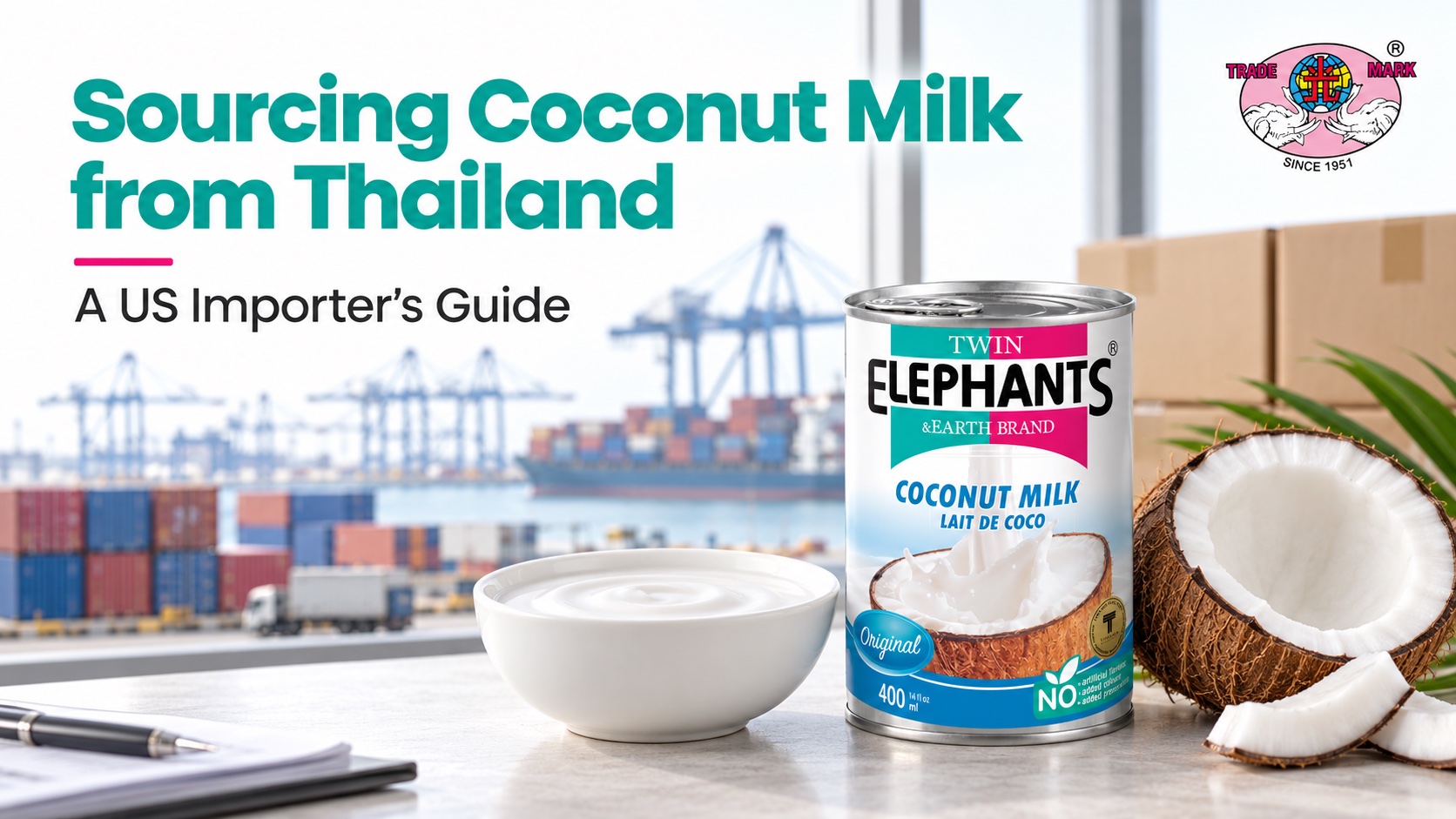
Sourcing Coconut Milk from Thailand: A US Importer’s Guide
Choosing a coconut milk supplier for US importers comes down to four things: the right product, reliable supply, clear documents and a realistic total cost. Start by deciding what your customers need, then compare suppliers using the same requirements.
This guide walks you through buying from Thailand, testing samples, checking import documents and requesting a quote. Use it to prepare for your first conversation with a factory or distributor.
Choose a US Distributor or a Thai Manufacturer
Buying Through a US Distributor
A US distributor may be a practical choice if you prefer local stock and domestic delivery. Ask about available products, minimum orders, remaining shelf life and how quickly you can reorder.
Confirm which import checks the distributor handles and which responsibilities remain with your business.
Buying Directly from Thailand
Buying directly from a Thai manufacturer lets you discuss the recipe, packaging and your own brand with the factory. You will also need to plan production, international shipping and US delivery.
Compare both options using your order volume, budget and delivery deadline. Our guide to choosing a coconut milk manufacturer explains what else to look for in a supplier.
Choose the Right Coconut Milk for Your Business

Match the Product to Its Application
Start with how the product will be used. Retail buyers need a suitable shelf size and label. Restaurants need good recipe results with minimal waste. Food manufacturers need coconut milk that works consistently in their production process.
For example, coconut milk that works well in curry may not perform the same way in coffee. Test it in the recipe or finished product you plan to sell.
Our canned and UHT coconut milk options include:
- Canned Coconut Milk (Original): 18–20% fat, in 165 mL, 400 mL and 2,900 mL packs.
- Coconut Milk UHT: 17–19% fat, in a 1,000 mL carton.
- Canned Coconut Milk (Light): 7–9% or 10–12% fat, in a 400 mL pack.
- Coconut Milk (Light): 5–7% or 10–12% fat, in a 400 mL pack.
- Coconut Milk (Rich): 17–19% fat, in 165 mL, 400 mL and 2,900 mL packs.
- Coconut Milk (Green Label): 17–19% fat, in 400 mL and 2,900 mL packs.
- Coconut Milk (Brown Label): 17–19% fat, in 400 mL and 2,900 mL packs.
- Coconut Cream: 20–22% fat, in 400 mL and 560 mL packs.
- Coconut Cream (Rich & Creamy): 20–22% fat, in 165 mL, 400 mL and 2,900 mL packs.
Fat content is a useful starting point when comparing richness and texture. Consider a light option when you want less richness, or compare original and rich coconut milk for curries, soups, sauces and desserts. Coconut cream is another option when a recipe calls for a richer coconut ingredient.
Ask for the latest product specification before choosing a size or fat level.
Agree on the Product Details
Ask the supplier for a product specification sheet showing fat content, ingredients, shelf life and storage instructions. Tell them what you need in terms of taste, texture and cooking performance. Your quality team can review the food safety and testing details.
Confirm the pack size, number of packs per case, date codes and shipping dimensions. Check that the cases and pallets suit your warehouse. This makes supplier quotes easier to compare.
Test Samples in the Same Way
Use the same recipe, quantities and cooking conditions for every sample. Compare taste, texture and how well each product handles heat. Record the sample code and results, then keep the approved specification for future orders.
Check Food Safety and US Import Documents

Ask the Factory for Its Documents
Before ordering, ask the factory for its current FDA registration details, food safety certificates and product specifications. Check that the factory name and address match the site making your order.
These four questions are a useful starting point:
- Can you share your current FDA facility registration details?
- Which factory will make my order?
- Can you send the food safety certificates and product specification?
- Who can help my US import team with document questions?
Have your US import team review the records before ordering. FDA registration is not product approval and does not replace other import requirements.
At Erawan Food, we have verified our US FDA documentation. Contact our team to request the records and specifications for the coconut milk you plan to order.
Confirm Who Handles Supplier Verification
The Foreign Supplier Verification Program (FSVP) covers checks that certain US food importers must carry out on overseas suppliers. Ask your import adviser whether it applies to your order and who will be responsible.
The factory supplies supporting records. The responsible US importer manages the required verification. Agree on these roles before ordering.
Ask your import team for a document checklist to send to the factory. FDA’s FSVP overview explains the requirements in more detail.
Review the US Label Before Printing
Agree who prepares the label and who approves it. Have a US labeling specialist check the product name, ingredients, allergens, Nutrition Facts where required, net quantity and business details.
Use current FDA labeling resources when planning the review. Claims such as organic or gluten-free need supporting evidence. A label used in another country may need changes for US sales.
Check barcodes, date codes, country-of-origin details and case labels too. Approve the final artwork before printing. For own-brand projects, our coconut milk OEM guide explains the preparation steps.
Compare Order Size, Total Cost and Delivery
Check the Minimum Order
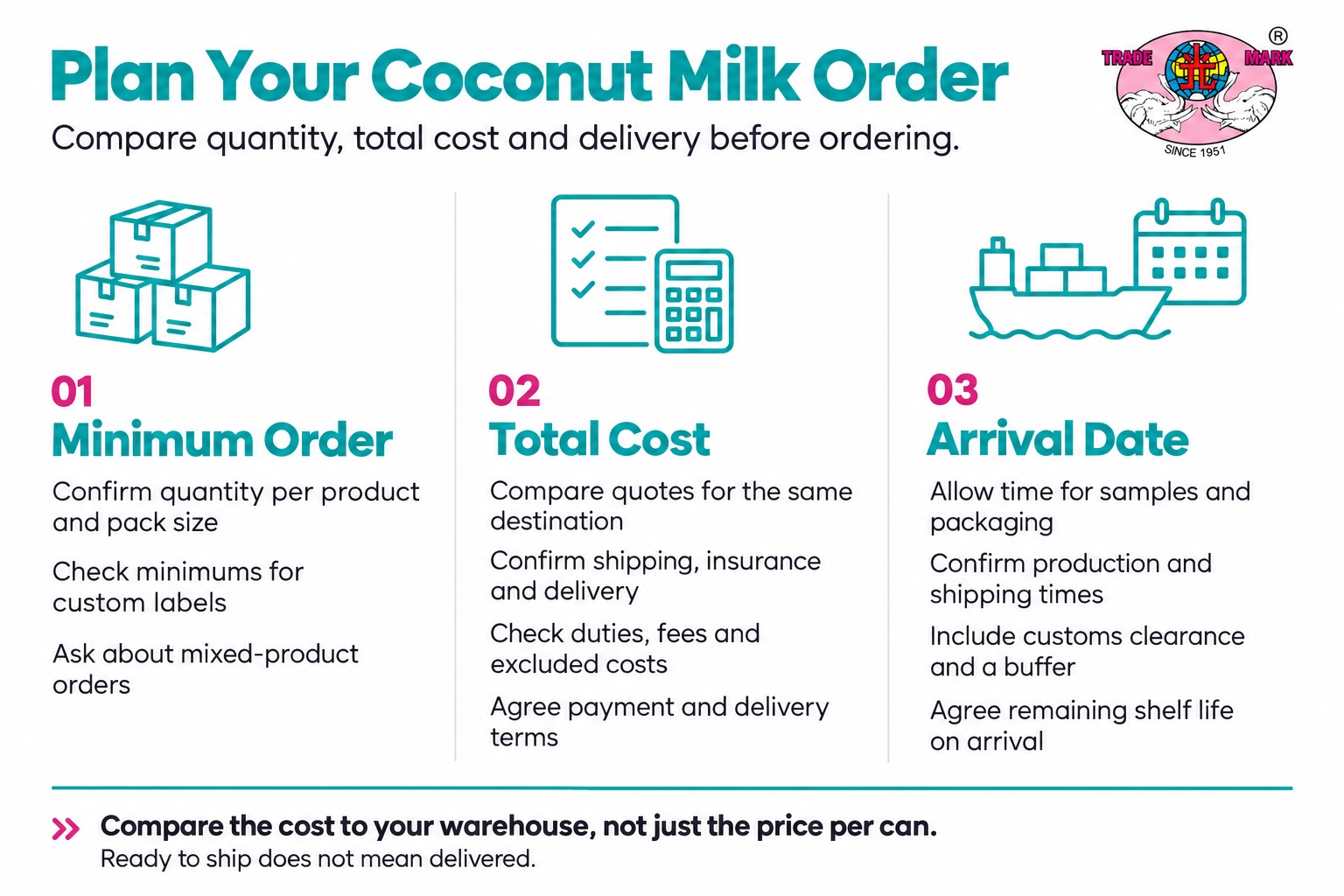
Ask for the minimum order quantity (MOQ) for each product, pack size and label design. For private-label coconut milk, printed packaging may have its own minimum. Check whether different products can be combined in one order.
Compare the Cost to Your Warehouse
Give each supplier the same quantities and US destination. State whether you want delivery to a port or to your warehouse so the quotes cover the same service.
Check the currency, payment terms and how long the quote is valid. Ask for the agreed delivery terms, known as Incoterms, and a clear explanation of who pays for shipping, insurance and delivery.
Ask what is excluded, such as duties, customs broker fees, inspections, storage and container-delay charges. Your customs broker can help estimate these costs. Compare the total cost, not just the price per can.
Plan Around the Arrival Date
Ask for separate estimates for sample approval, packaging, production, shipping and customs clearance. Confirm when production can start and what you need to approve first.
Allow time for delays and agree how much shelf life should remain on arrival. “Ready to ship” is not the same as “delivered to your warehouse.”
What to Send When Asking for a Quote
You do not need every detail settled before contacting a supplier. Start with the following:
- Your business: Company name, contact details and where you plan to sell.
- Product: Intended use, preferred fat level and ingredient requirements.
- Packaging: Can or carton, pack size and existing brand or your own label.
- Quantity: Estimated first order and how often you expect to reorder.
- Delivery: US port or ZIP code and preferred arrival date.
- Documents: Any food safety, import or labeling requirements from your team.
- Quote: Ask for minimum orders, sample options, payment terms and delivery costs.
Tell the supplier which details you still need help deciding. This gives them a useful starting point without delaying your inquiry.
Start Your Coconut Milk Sourcing Project with Erawan Food
At Erawan Food, our canned-food business dates back to 1951. We manufacture in Samut Sakhon, Thailand, and offer branded coconut products as well as private label and OEM supply.
Explore our coconut milk range and tell us how you plan to use it. We can discuss product specifications, samples, packaging and our verified US FDA documentation.
Ready to discuss your order? Contact Erawan Food with your preferred product, pack size, estimated quantity and US destination. Our team can help you review the options and request a quote for your project.
Frequently Asked Questions
Should a US Buyer Source Directly from Thailand or Use a US Distributor?
A US distributor may suit buyers who prefer local stock and domestic delivery. Buying from Thailand lets you discuss products and private-label requirements directly with the factory. Compare minimum orders, total costs and delivery times before deciding.
What FDA Documentation Can US Buyers Review?
Ask for current factory registration details and the documents your US import team needs. At Erawan Food, you can request our verified US FDA documentation alongside product specifications.
Who Handles FSVP for Imported Coconut Milk?
The responsible US importer handles the required supplier verification, with supporting documents from the factory. Confirm with your import adviser whether FSVP applies and who will manage it.
Can I Order Private-Label Coconut Milk for US Retail?
Yes. We offer private-label and OEM supply. Send us your preferred product, pack size, estimated quantity and label plans. Our team can discuss the available options. Have your US label reviewed before printing.
Which Pack Sizes and Fat Levels Are Available?
Our Original canned coconut milk is listed at 18–20% fat in 165 mL, 400 mL and 2,900 mL packs. UHT coconut milk is listed at 17–19% fat in 1,000 mL cartons. Other options include light coconut milk at 5–7%, 7–9% or 10–12% fat, Rich, Green Label and Brown Label coconut milk at 17–19% fat, and coconut cream at 20–22% fat. Ask our team for the latest specifications.
How Much Must I Order and How Long Will Delivery Take?
Minimum orders and delivery times depend on the product, packaging and destination. Send us your estimated quantity and US delivery location. Ask for both the production time and the expected arrival window.
What Should I Send to Get an Accurate Quote?
Send the product you need, pack size, estimated quantity, brand requirements and US destination. Add your preferred arrival date and any required documents. The checklist above can help you prepare.