Thai Canned Fruit: How Thailand Became the World’s Most Trusted Canned Fruit Manufacturer
Over the past several decades, Thai canned fruit has become a staple in supermarkets, foodservice kitchens, and industrial food production facilities around the world. What was once considered a niche tropical offering is now a mainstream product category in Europe, North America, the Middle East, and across Asia.
Thailand’s success as a canned fruit manufacturer is not accidental. It is built on strong agricultural foundations, advanced food processing technology, and a well-developed export ecosystem. At the same time, global consumer trends have shifted in ways that directly benefit tropical fruit exports. Health-conscious consumers are looking for fruit-based ingredients with clean labels. Plant-based diets continue to grow. Busy lifestyles drive demand for convenient, ready-to-use food formats.
Thai canned fruit aligns perfectly with these trends. It delivers exotic flavor, long shelf life, and consistent quality, making it highly attractive to B2B buyers seeking dependable suppliers.
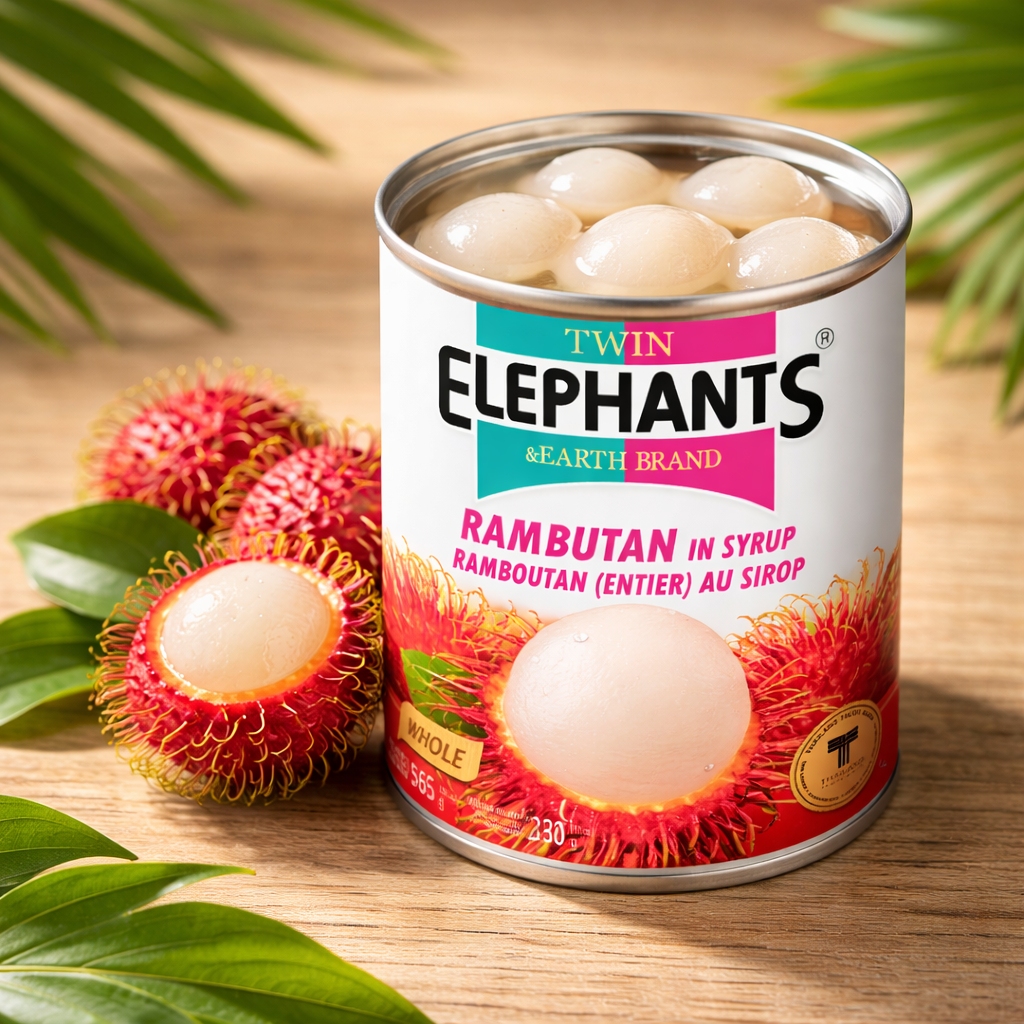
At Erawan Food, we’ve been part of this story since 1951. As Thailand’s #1 exporter of canned rambutan — and a trusted supplier of canned fruit like lychee, mango, longan, jackfruit, and more — we supply certified Thai canned fruit to partners in over 50 countries across Europe, North America, the Middle East, and Asia-Pacific.
Our Twin Elephants & Earth brand has earned recognition in international retail markets and was honored with Thailand’s Prime Minister’s Export Award since 2017. For brands seeking a private label or OEM partner, that same production expertise is available under your label.
Explore our full fruit and vegetable range here:
https://erawanfood.com/product-categories/fruit-vegetable
Diverse Tropical Fruit Offerings for Export

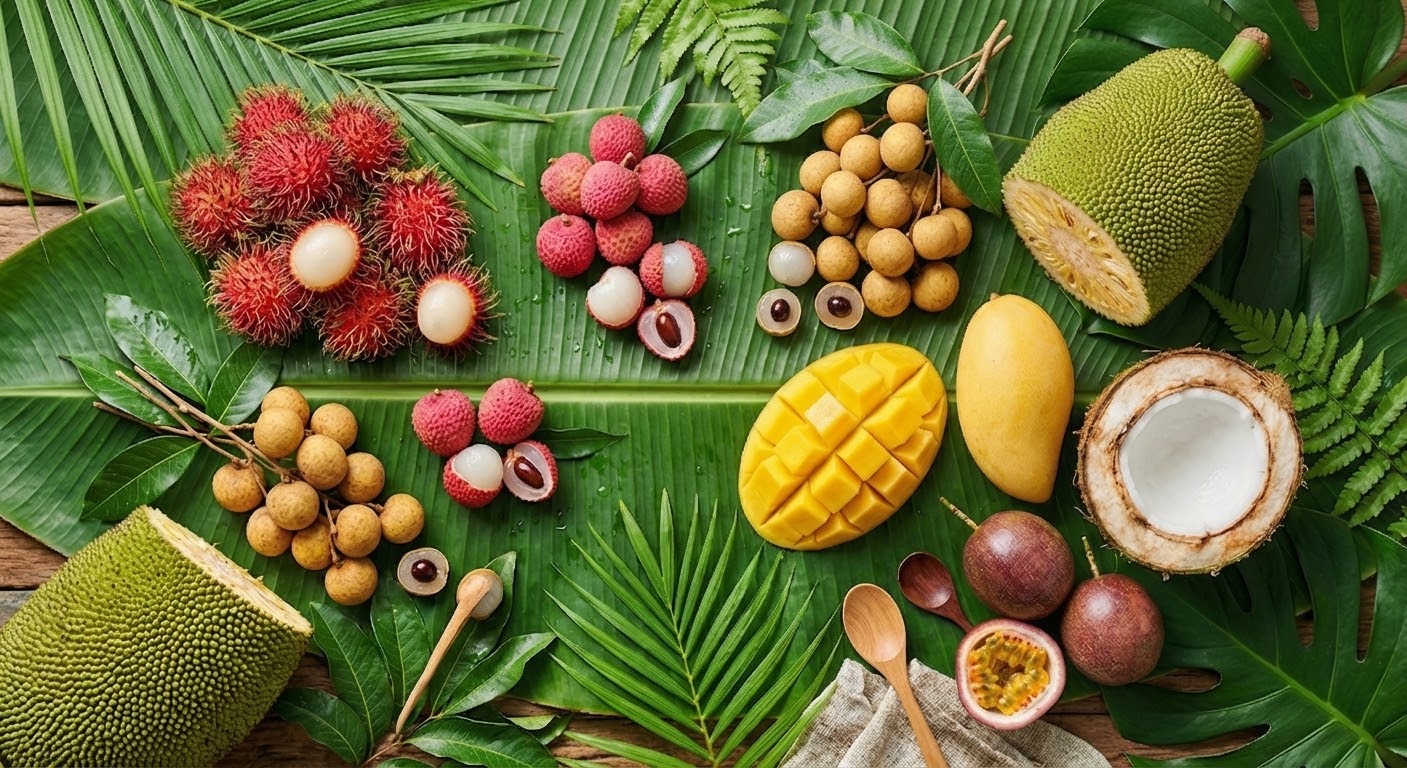
One of the key reasons Thai canned fruit stands out in global markets is product diversity. Thailand’s tropical climate supports a wide range of fruits that are difficult to cultivate in temperate regions.
Export-ready fruit varieties commonly include:
- Rambutan
- Lychee
- Longan
- Mango
- Jackfruit
- Toddy palm seed
These fruits are processed into multiple formats to suit different market needs. Options include peeled whole fruits, slices, diced pieces, and syrup-packed products.This flexibility allows importers and distributors to develop both mainstream and ethnic SKUs. In Western supermarkets, exotic fruit cocktails featuring rambutan or lychee add premium appeal. In Asian grocery chains, canned longan and toddy palm are traditional dessert essentials.
Of these varieties, rambutan holds a special place in Erawan Food’s export portfolio. We are Thailand’s #1 exporter of canned rambutan — a position built on years of direct relationships with rambutan farming communities and consistent quality control across peak-season harvests. For buyers building tropical fruit assortments or launching rambutan-based private label products, this is the level of sourcing confidence that matters.
For product developers, Thai canned fruit offers the opportunity to introduce tropical-themed product lines without relying on fragile fresh imports.
Production Process and Food Safety Controls
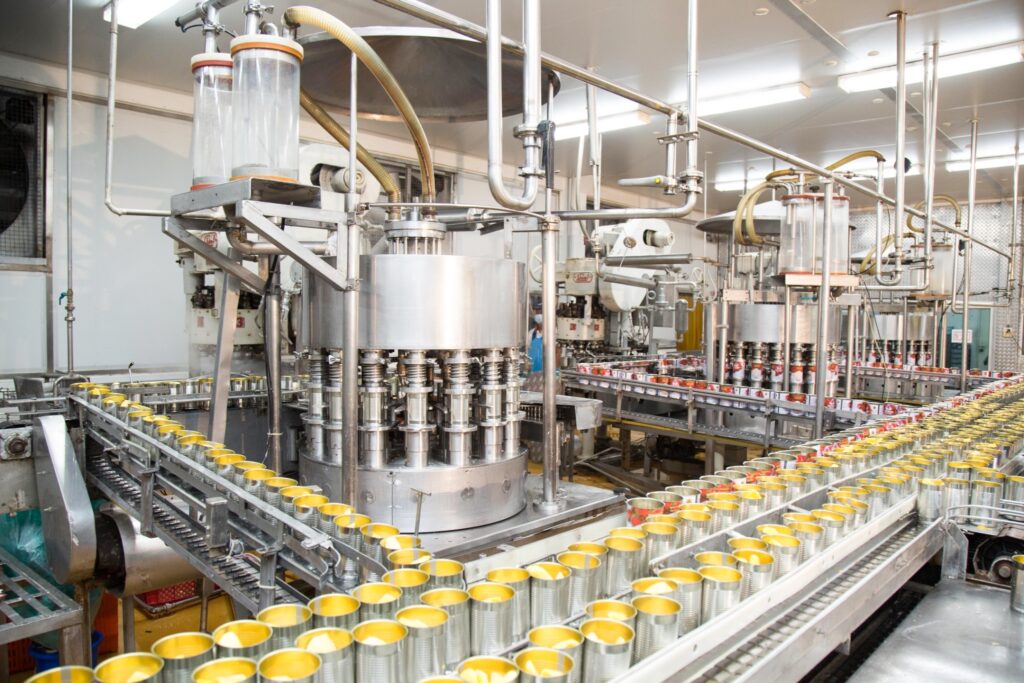
Global buyers increasingly demand transparency and standardized quality. Thai canned fruit manufacturers have invested heavily in production systems that meet international food safety standards.
The process begins with timed harvesting. Fruits are collected during peak ripeness to ensure optimal flavor, texture, and color. This timing is crucial because overripe fruit may compromise firmness, while underripe fruit may lack sweetness.
After harvesting, fruits undergo:
- Automated sorting and grading
- Hygienic washing and peeling
- Mechanical or manual deseeding
- Precise cutting or whole-fruit preparation
- Heat-based canning and sterilization
Heat processing ensures microbiological safety while preserving natural flavor and texture. Modern canning lines are designed to minimize human contact, reducing contamination risk.
Quality control teams conduct batch testing for:
- Brix levels to measure sweetness
- Color uniformity
- Texture consistency
- Syrup concentration
These quality checks help maintain consistency across large export volumes. For global brands, this consistency is essential when launching private label products across multiple markets.
Thailand’s Edge in Export Readiness
Beyond production quality, Thailand offers a structural advantage as an export hub.
Certified factories operate under internationally recognized standards such as BRC, IFS, HACCP, and GHPs. These certifications simplify import procedures for regulated markets, including the European Union, the United States, Japan, and Middle Eastern countries.
Thailand’s geographic position also supports efficient trade. Major ports and logistics hubs facilitate containerized shipping worldwide. Established freight networks allow for both full container loads and mixed shipments.
Importantly, Thai canned fruit manufacturers have developed strategies to ensure supply continuity even during off-seasons. Cold storage and planned processing schedules help stabilize inventory. This reduces supply disruptions and protects buyers from seasonal volatility.
For procurement teams evaluating risk, Thailand’s export infrastructure adds a layer of reliability beyond agricultural capability alone.
Erawan Food’s manufacturing facility operates under internationally recognized certifications including BRC, IFS, BSCI, and GHPs — standards required by major retailers and food companies across Europe, North America, and the Middle East. We also hold the Thailand Trust Mark, awarded by Thailand’s Ministry of Commerce, which certifies product quality, environmental responsibility, and ethical labor practices throughout our supply chain.
For procurement teams, these certifications reduce audit complexity and provide the documentation assurance needed for smooth import procedures in regulated markets.
B2B Applications Across Industries
Thai canned fruit is not limited to retail shelves. Its applications span multiple B2B sectors.
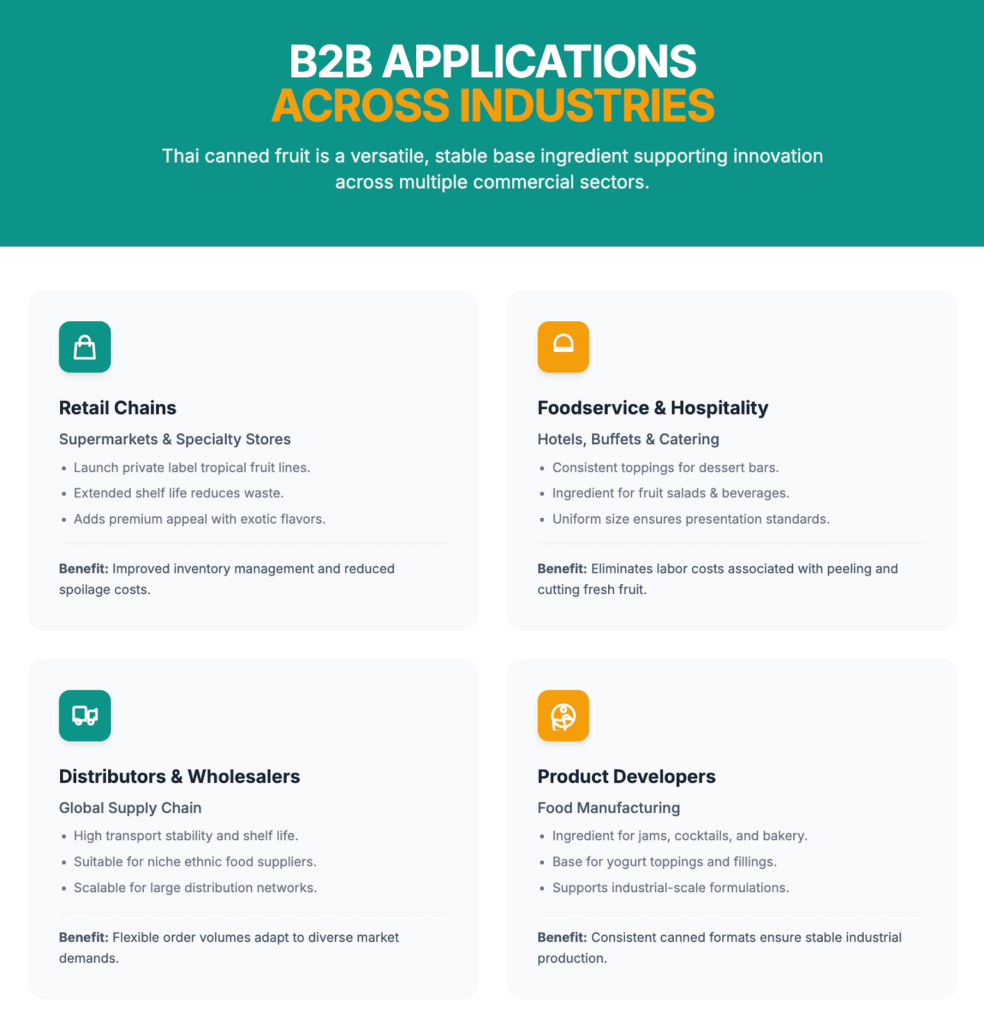
Retail Chains
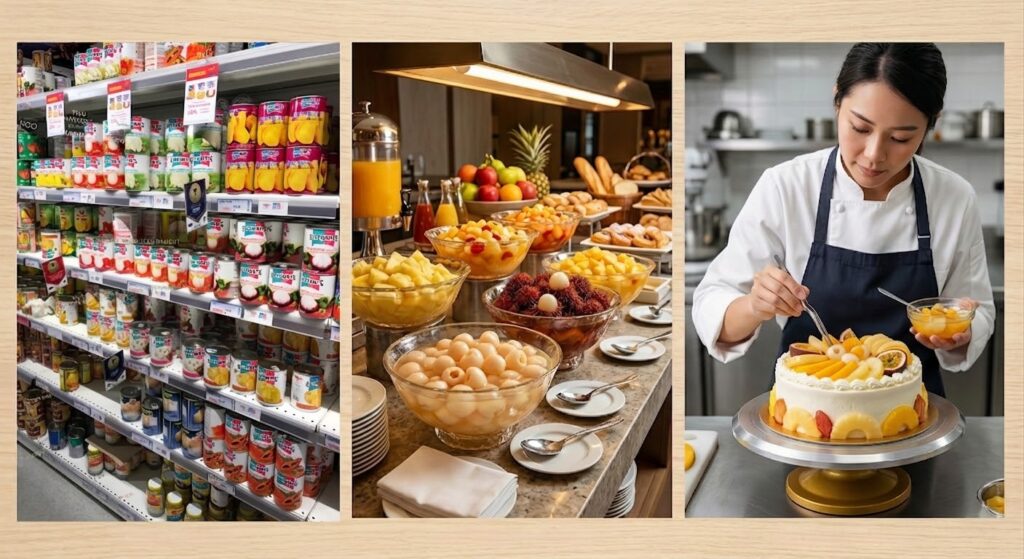
Supermarkets and specialty food stores often launch private label tropical fruit lines. Canned fruit provides extended shelf life, reducing waste and improving inventory management. Thai canned fruit adds premium appeal through exotic flavor profiles.
Foodservice and Hospitality
Hotels, buffet operators, dessert bars, and catering services use canned fruit for fruit salads, toppings, and beverage preparation. Uniform size and texture allow chefs to maintain presentation standards without the labor of peeling and cutting fresh fruit.
Distributors and Wholesalers
Wholesalers value the long shelf life and transport stability of canned fruit. Flexible order volumes make it suitable for both large distributors and niche ethnic food suppliers.
Product Developers
Food manufacturers incorporate Thai canned fruit into fruit cocktails, jams, yogurt toppings, bakery fillings, and ready-to-drink beverages. The consistency of canned formats supports industrial-scale production.
In a market driven by innovation, canned fruit provides a stable base ingredient that can be repurposed across multiple product categories.
Meeting Modern Consumer Expectations
Today’s consumers demand more than taste. They seek clean labels, traceability, and responsible sourcing. Certified Thai canned fruit manufacturers respond to these expectations through documented supply chains and transparent production practices.
Traceability systems allow buyers to track fruit origins and production batches. Social compliance certifications demonstrate ethical labor practices. For international brands, these factors contribute to stronger consumer trust.
At the same time, tropical fruit aligns with plant-based and wellness-oriented diets. Mango, lychee, and rambutan offer natural sweetness and vibrant color without artificial additives.
As global consumption patterns evolve, Thai canned fruit remains adaptable to changing demands.
A Strategic Sourcing Choice for Global Buyers
Thai canned fruit has earned its position in global markets through quality, variety, and export expertise. From diverse tropical offerings to certified production and advanced logistics, Thailand provides a comprehensive solution for B2B buyers.
Whether you are a retailer developing private label products, a foodservice distributor seeking reliable supply, or a product developer launching a tropical-inspired line, partnering with a trusted canned fruit manufacturer in Thailand can strengthen your supply chain.
Looking for a reliable canned fruit manufacturer with quality, variety, and export know-how?
Work with Thailand’s Most Experienced Canned Fruit Manufacturer
With over 70 years of export expertise, Erawan Food brings sourcing depth, certified production, and OEM flexibility to every partnership. Whether you’re building a private label tropical fruit range, securing high-volume supply for foodservice, or sourcing a specific variety like rambutan or lychee for a new product line — we’re the partner built for it.
Explore our full fruit and vegetable range for private label and wholesale opportunities:
https://erawanfood.com/product-categories/fruit-vegetable
Contact Erawan Food
Email: [email protected]
Address: 88 All Erawan Building, Industrial Ring Road, Chongnonsee, Yannawa, Bangkok 10120, Thailand
Office Tel: +66 2 681 0251–59
Sales Team: +66 86 900 7777
Frequently Asked Questions
Why is Thai canned fruit popular in global markets?
Thai canned fruit offers consistent quality, exotic varieties, long shelf life, and certified production suitable for international trade.
What fruits are commonly exported in canned form from Thailand?
Rambutan, lychee, longan, mango, jackfruit, and toddy palm are among the most common export varieties.
Are Thai canned fruit manufacturers certified?
Yes. Reputable manufacturers hold certifications such as BRC, IFS, HACCP, BSCI and GHPs to meet global food safety standards.
Can canned fruit be customized for private label brands?
Yes. Many Thai manufacturers provide OEM services, including customized syrup levels, packaging sizes, and labeling.
How long is the shelf life of canned fruit?
Most canned fruit products have a shelf life of up to three years when stored in appropriate conditions.